
Picking a run up
A loop that runs for a week will be stopped and started: a machine goes down, somebody presses esc, or a turn takes the process with it. A flow (a file on disk) may say it can be picked up where its last run left off. A flow that says so keeps what it is tracking in a dict.
Try it
Run a resumable flow twice with the same command:
hmz exec -f nightly -a claude/claude-opus-5:high "keep the tests green"
hmz exec -f nightly -a claude/claude-opus-5:high "keep the tests green"   # round 2, not round 1
The second run finds the state the first run left behind. It carries on from round 2, not round 1.
Saying so
To make a flow resumable, give it resumable=True and a dict. The dict is where you keep what the loop itself knows: which round it is on, which files it has been through, what it has decided so far. It is not a second copy of the transcript. The backends keep that, and the run's cycle (what the run writes down) already says which sessions it opened.
"""A Ralph loop that knows which round it is on."""

from typing import Any

from hmz.agents import AgentBase
from hmz.flows import flow


@flow(resumable=True)
def run(agents: tuple[AgentBase], task: str, state: dict[str, Any]) -> None:
    (agent,) = agents
    while True:
        state["round"] = state.get("round", 0) + 1   # writing it into the state saves it
        agent(f"{task}\n\nRound {state['round']}.", suppress=True)
The dict is the flow's last argument, after the config for a flow that takes one. A flow that says resumable=True but declares no such argument is handed a dict it has nowhere to put. It says so at the first call, before a turn has been taken, rather than starting over in silence.
A flow that says nothing runs from the top every time, which is what every flow did before this.
Where it lives
What a flow keeps goes in the cycle of the run that wrote it, as state.json. It sits beside that run's own record and the links to its sessions:
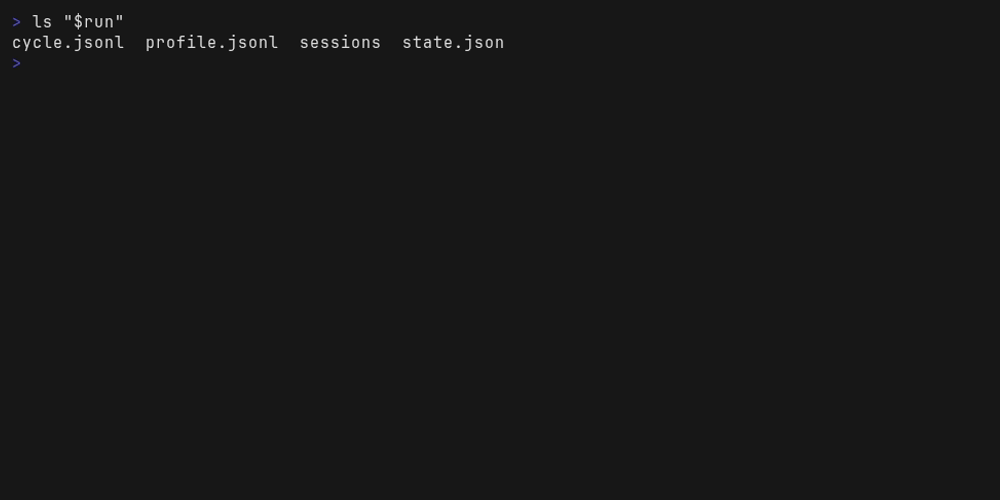
The state is keyed by flow. A flow that calls another one is two flows, and each keeps its own state side by side in the one file, neither writing the other's:
{"nightly": {"round": 12}, "official/rlar": {"seen": ["src/pay.py"]}}The key is the name the flow was run under. So -f nightly and the path to that same file are two names and two states.
When it is saved
As the flow writes it. Setting a key, removing one, or calling update or setdefault writes the file again. A run worth picking up is one that was stopped or killed rather than one that ended tidily. State written only at the end is state such a run has none of.
Writing inside a value the state holds is a change no mapping can see. Appending to a list, or writing into a dict of its own, is saved when the run ends.
Keep to what JSON holds. Anything else is written as its str, so a Path put in comes back out a string. A value that cannot be written at all leaves the last save standing rather than ending the run. A loop that died because it could not write down where it had got to would be worse than one carrying on from a round ago.
Running it again
Running the flow again is what picks it up. There is no flag for it:
hmz exec -f nightly -a claude/claude-opus-5:high "keep the tests green"
hmz exec -f nightly -a claude/claude-opus-5:high "keep the tests green"   # round 2, not round 1
It carries on from the last run of that flow in this directory that left anything. A run that wrote nothing is nothing to pick up, so what carries on is the run before it. Runs are kept under the workspace they ran in. The same flow in another checkout carries on from that checkout's own last run.
It is found by what the state holds rather than by what the run was of. That is what lets a flow that was called by another be picked up too: it wrote under its own name, and that is where it is looked for.
Carrying an older one on
/cycles is every run of a flow in this directory, newest first. It shows when the run happened, which flow it was, what it was asked to do, how many sessions it opened, and a mark on the runs whose flow says it can be picked up. Enter opens what there is to do with the run under the cursor:
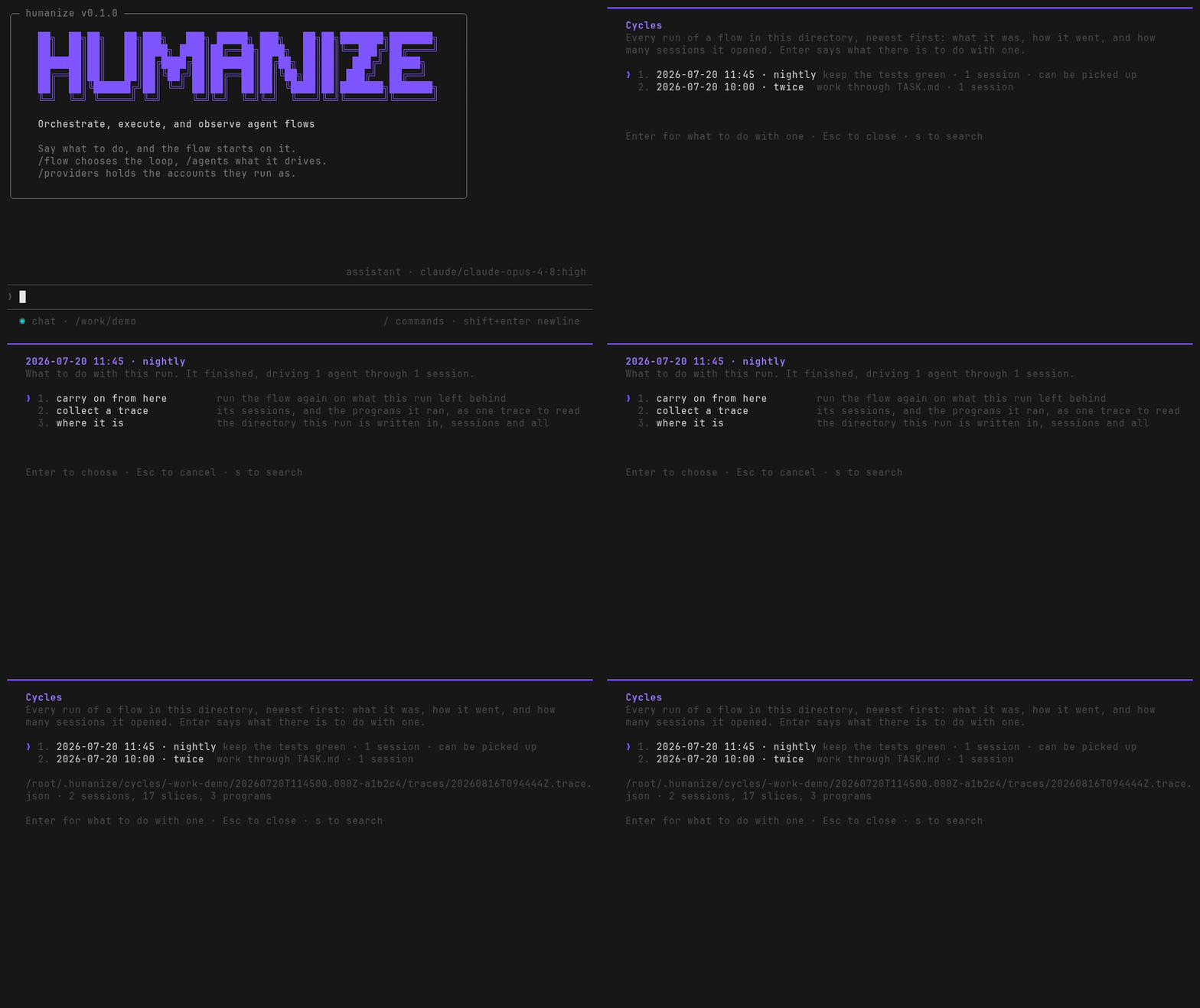
| carry on from here | Run the flow again on what this run left behind |
| collect a trace | Its sessions, and the programs it ran, as one trace |
| where it is | The directory the run is written in, sessions and all |
The mark in the list and that first row are one question, asked of the flow rather than of the run. A flow is a file on disk and may have been rewritten since. What can happen next is what it says today, rather than what it said when the run happened.
A flow marked resumable=True after a run of it has that older run marked and offered too. Carrying that one on runs its flow, its agents and its task, on nothing: a run taken while the flow still said nothing left no state behind to pick up.
A flow that has since dropped the mark has neither the mark nor the row, whatever the run wrote down at the time. Where the row is gone, the reason for it stands under the list.
A flow that will not load at all reads as one that says no. A flow that cannot be read cannot be run, which is what carrying on would come to.
Collecting a trace is offered for every run, whatever its flow says.
Carrying one on is refused while a flow is running, and the refusal is said on the sheet rather than on the way out. The question is still worth answering, and esc is what stops a flow.
Naming a run rather than taking the last one is the same thing from Python:
from hmz.runner import Runner

Runner("nightly", agents, resume=at).run("keep the tests green")
at is that run's own directory: what where it is prints, and what hmz.cycle.cycles() lists.
What carrying on runs
The flow, its agents and what it was asked to do all come off the run, rather than off whatever the interface happens to be set up on. Picking a run up means running what ran. An agent swapped under it would be a different run wearing its name.
Each agent starts at the backend, model, effort, permission and account the run wrote down.
Two things are not the run's. The person at the prompt is not an agent anybody chose, so a flow that talks to one is handed a fresh one. How the flow was set up is not written in the run, so that is what this project remembers for the flow now.
A cycle is never reopened
What carries on is written into a cycle of its own. Its began line says which run it was picked_up from.
The run being picked up is read and left exactly as it was. Carrying the same run on twice is two runs from one starting point, rather than one record with two runs inside it.
This is what makes a week of stops and starts readable afterwards. Each stretch is a run, with its own sessions, its own trace and its own end, rather than one enormous cycle claiming to have begun on Monday.
See also
- Tracing — what else a run writes down, and reading one back
- Stopping — what makes a run worth picking up
- Flows › A flow that can be picked up
- TUI › Commands